
Introduction
Drylab is a comprehensive AI workspace for biomedical analysis, with tools across genomics, proteomics, imaging, machine learning, and workflow automation.
Drylab is a broad, comprehensive environment designed to support many types of biomedical analysis in one place. It includes a wide range of tools across genomics, proteomics, metabolomics, imaging, flow cytometry, machine learning, and workflow automation, and prioritizes flexibility and coverage.
Drylab in 4 minutes
A quick video tour of the Drylab platform and the Desktop App.
Platform overview
Desktop App: the best choice for large-scale data and security
Main elements
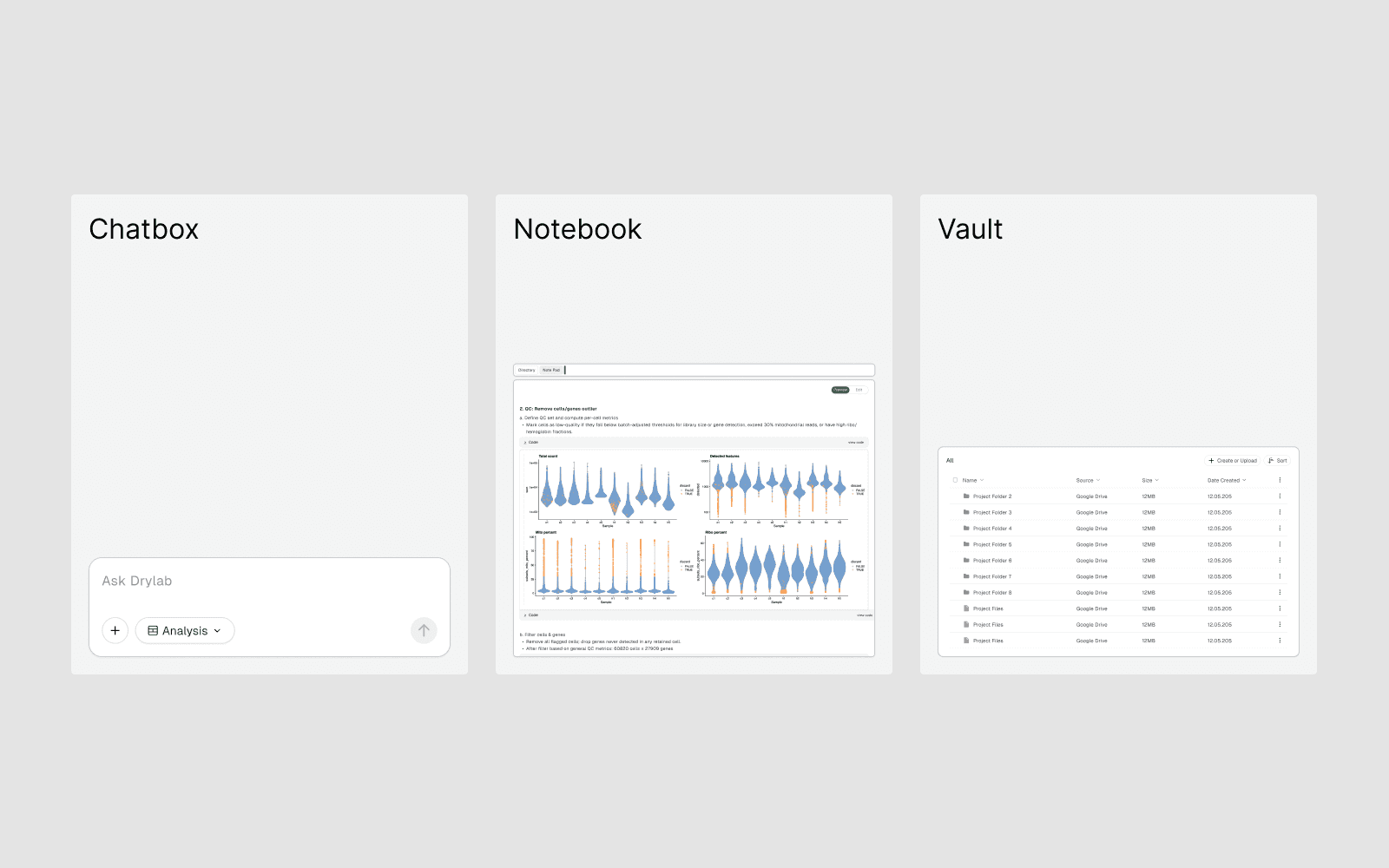
Drylab is organized around three main elements: the Chatbox, where you describe what you want; the Notebook, where the AI writes and runs code; and the Vault, where your files persist across sessions.
Core capabilities
- Multi-omics analysis: bulk and single-cell RNA-seq, genomics and variant analysis, epigenomics (ChIP-seq, methylation), proteomics and metabolomics, systems biology and pathway analysis.
- Imaging and pathology: microscopy image analysis, cell segmentation and tracking, histology and whole-slide imaging, feature extraction.
- Flow and mass cytometry: preprocessing, clustering and population discovery, integration with transcriptomic data.
- Drug discovery and chemistry: molecular descriptors and fingerprints, QSAR modeling, docking preparation and ADMET prediction.
- Machine learning and statistics: classical and modern ML models, AutoML and hyperparameter tuning, Bayesian modeling, model interpretation and explainability.
- Workflow automation: reproducible pipelines, scripted end-to-end analyses, scalable batch processing.
For example packages in the sandbox image, see Compute Environments.
Typical applications
- Multi-modal studies (e.g. RNA-seq + proteomics + imaging)
- Core facilities and platform labs
- Method development and benchmarking
- Projects with evolving or unclear analysis needs